
 17 hours ago
Könül KhalilovaNews editor, BBC Azerbaijani

 Social Media
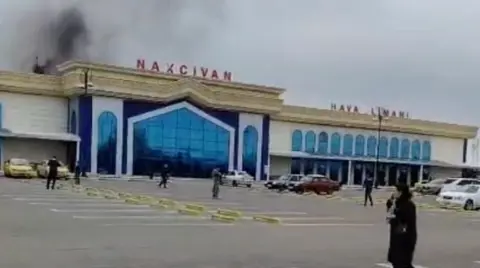
The airport in Nakhchivan sustained a direct hit and Ilham Aliyev said the strike would not go unanswered
Azerbaijan has said it is pulling its diplomatic staff out of Iran after it accused Iran of launching four drones across the border into the Azerbaijani exclave of Nakhchivan.
The airport terminal was hit, a drone exploded near a school, injuring civilians, and another drone was shot down, as the war in the Middle East spilled over Iran's northern border.
Azerbaijan's President Ilham Aliyev condemned the "act of terror", demanding an explanation and apology from Tehran.
On Friday he went further, announcing the withdrawal of staff from Azerbaijan's embassy in Tehran and consulate in Tabriz "for their own safety", and state media said the military had been placed on maximum combat readiness.
Aliyev also touched on Iran's ethnic Azerbaijani population on Thursday - a sensitive subject for Tehran.
Iran denies any role in Thursday's strikes and has suggested the attack may have been an Israeli false‑flag operation.
Azerbaijan, a small but strategically important Caspian country bordering Russia, Iran, Armenia and Georgia, is now being pulled closer to the heart of a much bigger confrontation.
Nakhchivan is an isolated Azerbaijani territory bordering Iran, Turkey and Armenia, making it particularly exposed during times of conflict.
The drones triggered Aliyev's strongest public attack on Tehran since he took office.
He said the Iranian forces behind the strike were "ugly, cowardly and disgusting" - an unusually blunt personal insult for a head of state.
But his anger went beyond words, saying that "independent Azerbaijan is a place of hope for Azerbaijanis living in Iran".
Baku has long avoided this line because of how sensitive it is for Tehran.
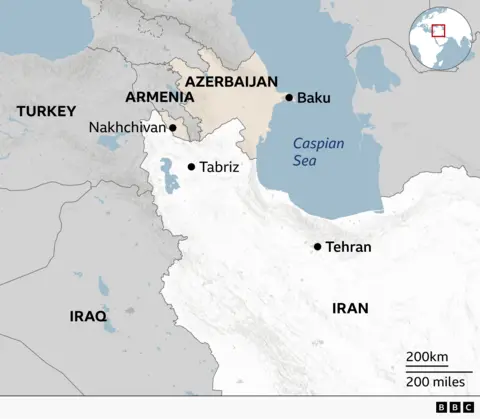
Iran is home to an estimated 20-25 million ethnic Azeris, who make up its largest minority group and are concentrated in the north-west along the Azerbaijan border.
The Islamic Republic has consistently regarded their identity and political affiliations as issues of utmost sensitivity. Tehran views any notion of Azerbaijani identity extending beyond its borders as a potential challenge to internal unity.
Aliyev has rarely spoken about Iranian Azeris in such explicitly aspirational terms and doing so now appears to be a calculated move.
Iran is under intense pressure not just from the war but from internal unrest and political uncertainty and Aliyev's message comes across as a warning to Tehran: any attempt to pressure Azerbaijan militarily or diplomatically could result in a response from Baku, including one that affects Iran's internal stability.
Iranian Azerbaijanis have long complained that they are denied basic cultural rights, including education in their own language.
Several Azerbaijani activists, journalists and language campaigners are currently imprisoned in Iran, facing charges ranging from "propaganda against the regime" to "conspiracy against national security".
They are also a politically significant community. This week the exiled crown prince, Reza Pahlavi, has been urging Iranian Azerbaijanis, among other ethnic minorities, to rise up against the regime.
 EPA
EPA
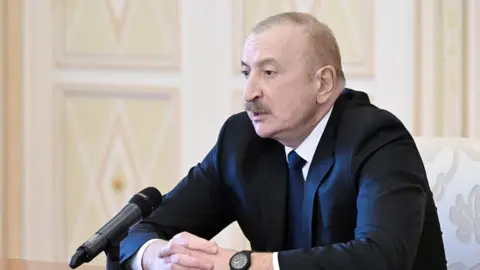
President Ilham Aliyev's anger went beyond words as he addressed the issue of Iran's ethnic Azerbaijani population
Iran's current President, Masoud Pezeshkian, is himself an ethnic Azerbaijani and the late Ayatollah Ali Khamenei - who was killed in the opening salvo of US-Israeli strikes on Saturday - was also claimed to have Azerbaijani roots.
Some of Iran's shahs across the centuries were ethnic Azerbaijanis as well.
One of its most influential rulers, Shah Ismail Khatai, even used Azerbaijani as the first language of his palace in the 16th Century - a reminder of how deeply Azerbaijani culture once shaped the Iranian state.
But none of these facts have helped Azerbaijanis in Iran to have lessons taught in their own language.
Despite their shared Shia Muslim identity, Iran and Azerbaijan have grown apart politically, and tensions worsened after Azerbaijan's military victories in the 2020 and 2023 Karabakh wars, which were helped by Turkish and Israeli-made weapons.
Iran views Baku's close defence partnership with Israel as a serious threat.
Iranian officials and media have repeatedly accused Azerbaijan of helping Israeli intelligence operate along Iran's northern frontier - claims Azerbaijan denies.
Azerbaijan's ties with Israel extend beyond security. Israel relies heavily on Azerbaijani oil, and the two countries maintain close political and intelligence co-operation.
For Tehran, this collaboration is at the centre of its suspicion.
Azerbaijan, for its part, has long resented Iran's political and military support for neighbouring Armenia, seeing it as direct interference in a conflict central to its own security.
That history of mistrust is an important backdrop to Thursday's escalation, shaping how Baku interprets every move coming from Tehran.
Iran opposes the establishment of a land connection between Azerbaijan and its Nakhchivan exclave. Tehran has consistently objected to Armenia potentially allowing Azerbaijan a land corridor to the territory.
Azerbaijan is a major energy supplier, and its crude oil reaches global markets through a 1,768km (1,100-mile) pipeline that goes via Baku on the Caspian Sea through Georgia to Turkey's Mediterranean coast.
That pipeline carries more than a million barrels of oil a day and provides Europe with a vital supply route that bypasses both Russian and Iranian territory.
It also supplies Israel with a significant proportion of its oil.
As a result, the pipeline is viewed as a significant potential target for Iran, and any threat of disruption could raise security fears and jolt energy markets.
Both Iran and Azerbaijan deny seeking escalation.
Aliyev insists Azerbaijan "will not participate" in military operations against Iran, and Tehran continues to reject responsibility for the drone attack.
But Aliyev's decision to talk openly of Azerbaijan being a "place of hope" for Iranian Azeris introduces a new and potentially unpredictable element.
Aliyev has pointed out to Tehran that he was the sole foreign leader to visit any Iranian embassy to express condolences following the killing of Khamenei, and that he personally responded to a request to help evacuate Iranian embassy staff from Lebanon.
Now, he says, Iran has repaid those gestures with drone strikes on Azerbaijani territory, something he views as a deep betrayal.


